

The STUDY GUIDE for you is at the bottom of this page.
Facebook | X | Instagram | YouTube | LinkedIn | Threads | TikTok
If you have worn a badge, a uniform, or carried a weapon in service to your country, you understand authority from the inside. You have been on both ends of the chain of command. You have given orders and followed them. You have made calls that kept people alive, and maybe carried some that did not go the way you hoped. You know what it costs to serve under authority, and you know what it costs to be the one responsible for the people under yours.
Most of the time, the job and your conscience lined up. You enforced the law. You protected people. You stood in the gap so others did not have to. That is honorable work, and Scripture affirms it.
But some of you have been in situations where the order you received sat wrong. Maybe you followed it anyway and have carried that ever since. Maybe you pushed back and paid a price for it. Maybe you are still trying to sort out whether what you did was right, whether God holds it against you, or whether obedience to the chain of command is supposed to be unconditional.
This study is for you. We are going to work through what the Bible actually says about obedience to authority, where the limits are, and how men and women who served God under real pressure navigated that tension long before any of us were born.
The Foundation: Authority Is Not the Enemy of Faith
Before we talk about where the limits are, we have to establish what Scripture says about authority itself. Because there is a wrong way to read this topic, and it leads to a posture of suspicion toward structure and rank that the Bible does not support.
Paul writes this in Romans 13:1-2:
“Let every person be subject to the governing authorities. For there is no authority except from God, and those that exist have been instituted by God. Therefore whoever resists the authorities resists what God has appointed, and those who resist will incur judgment.” (Romans 13:1-2, ESV)
That is a strong statement. Paul is writing to believers living under Roman rule, which was not a gentle or particularly just government. And yet he tells them that governing authority itself comes from God. The structure of authority, rank, and lawful command is part of how God maintains order in a world that would otherwise tear itself apart.
For those of you who have served, this should resonate. You have seen what happens when authority collapses. You have worked the calls that come in after order breaks down. You know that structure, even imperfect structure, holds things together in ways the people inside it often cannot fully see.
Romans 13 is not telling you to be naive. It is telling you that obedience to lawful authority is not just a duty. In most circumstances, it is an act of obedience to God. When you served faithfully under your chain of command, enforced just laws, and protected your community, you were not choosing between your job and your faith. You were living them out together.
But Romans 13 contains a word that matters more than it might appear at first reading. Paul says to be subject to the governing authorities. The word “governing” implies a scope. Authority is not unlimited. It operates within a jurisdiction. And when authority acts outside that jurisdiction, the equation changes.
When the Chain of Command Gets It Wrong
Early in my career, our city had a problem with a street evangelism group called Cry to God. They would set up on downtown corners and deliver their message to anyone who walked by. The problem was not that they were preaching. The problem was their method. They used perverse, degrading language to describe people and tell them why they were going to hell. On one occasion I witnessed them positioned outside a restaurant that was holding a fundraiser for a child with cancer. They announced publicly, to everyone within earshot, that the child was dying because of the mother’s sin, and they used language to say it that I will not repeat here.
That is not the gospel. That is not godly speech. But because of the First Amendment, there was not much anyone could legally do about it. The speech was protected. People tried to ignore them, and most of the time that was the right call, because engaging only gave them an audience.
The city eventually decided it had had enough. They passed an ordinance stating that free speech in groups of two or more was only permitted on Wednesday evenings at eight o’clock in a specific downtown park. That was it. That was the law they came up with.
I sat in a staff meeting and listened to the chief and the city attorney explain what actions officers should take when these people violated that ordinance. I raised my hand and told the room directly that the law was unconstitutional. I told every officer present that they should disregard what they were being instructed to do. When calls came in about this group, I advised my people over the radio to stand down and not respond.
I want to be precise about what I was doing, because it would be easy to misread it. I was not protecting that group’s message. I was not able to stop what they were doing to that family outside the restaurant, and I had no legal basis to try. The speech was protected and my hands were tied on that front. What I was standing up for was the constitutional structure itself. The city’s response to an ugly situation was to pass an ordinance that was more dangerous than the problem it was trying to solve. The moment government can decide which speech is permitted and when, everyone’s speech is at risk, including the speech of every street preacher, every pastor, and every believer sharing the gospel on a public corner. That ordinance had to go.
The ordinance was eventually struck down. It never would have survived a legal challenge, and it should not have. But standing up the way I did had consequences. I was on the lieutenant’s list. I was in position to get that promotion. It did not come.
The constitutional parallel to what Scripture teaches about authority is direct. My chain of command had legitimate authority, and Romans 13 applies to them. But the ordinance they were directing me to enforce violated a higher legal authority that existed above them. You apply authority correctly by honoring the full hierarchy, not by following the lower authority when it overreaches the higher one. That principle runs through every example we are about to look at in Scripture.
The Apostles and the Line That Cannot Be Crossed
Acts 5 establishes what happens when authority crosses a line it was never authorized to cross.
Peter and the other apostles had been arrested for preaching about Jesus. They were brought before the Sanhedrin, the highest religious authority in Israel, men with real power to imprison and execute. They had already been warned once. Now they were being ordered to stop speaking in the name of Christ entirely.
The response is direct:
“We must obey God rather than men.” (Acts 5:29, ESV)
Read that carefully. This was not a general statement about resisting authority. It was not personal preference dressed up in religious language. It was a response to a specific, concrete command that directly contradicted what Christ had told them to do. Jesus had told them to go and make disciples. The council was telling them to stop. Those two commands cannot both be obeyed at the same time. There was no middle ground and no creative interpretation that would let them satisfy both. They obeyed the higher authority.
The apostles were not men with a general posture of resistance toward government. Peter himself writes in 1 Peter 2:13-14:
“Be subject for the Lord’s sake to every human institution, whether it be to the emperor as supreme, or to governors as sent by him to punish those who do evil and to praise those who do good.” (1 Peter 2:13-14, ESV)
The man who said “we must obey God rather than men” also told believers to be subject to the emperor. There is no contradiction there. The principle is consistent throughout. Authority is legitimate and worthy of obedience. When authority steps outside its God-given limits and commands what God forbids, the hierarchy becomes clear. God’s authority stands above all others.
For those of you who have been in situations where an order required something you knew was wrong, this passage does not give you permission to look back on every difficult call with suspicion. Most orders are legitimate and deserve your compliance and your best effort. But this passage does establish clearly that blind obedience is not a virtue Scripture endorses. There is a line. It is real. And knowing where it is matters before you are standing at it.

Daniel: Steady Under Pressure
The clearest Old Testament example of a warrior navigating this tension is Daniel. And what is striking about Daniel is not how dramatic his resistance was. It is how quiet and settled it was.
Daniel served inside a foreign government. He was a capable administrator, trusted by kings, given real authority and real responsibility. He was not a man with a chip on his shoulder toward the system he served. He worked within it and he served well. His faithfulness to the government he worked for is part of what made his faithfulness to God visible.
Then came Darius’s decree. Anyone who prayed to any god or man other than the king for the next thirty days would be thrown into the lions’ den. The decree carried the full weight of Persian law, which under the Medes and Persians could not be revoked once issued. This was not a gray area. Daniel understood exactly what the law said, what the penalty was, and what his choice meant.
Daniel 6:10 records what he did:
“When Daniel knew that the document had been signed, he went to his house where he had windows in his upper chamber open toward Jerusalem. He got down on his knees three times a day and prayed and gave thanks before his God, as he had done previously.” (Daniel 6:10, ESV)
Notice what that verse says at the end. “As he had done previously.” Daniel did not make a dramatic public stand. He did not organize resistance, circulate a petition, or make speeches in the public square. He simply continued doing what he had always done. His obedience to God was not a reaction to the decree. It was his life. The decree revealed where his allegiance was. It did not create it.
He was arrested. He was thrown into the lions’ den. Daniel 6:23 records the outcome:
“Then the king was exceedingly glad, and commanded that Daniel be taken up out of the den. So Daniel was taken up out of the den, and no kind of harm was found on him, because he had trusted in his God.” (Daniel 6:23, ESV)
Daniel’s trust was not in his own certainty that he was making the right call. It was in God. He did not know how the lions’ den would end. He accepted the cost of obedience and trusted the outcome to God. That is the model Scripture gives us for what settled allegiance looks like under pressure.
Shadrach, Meshach, and Abednego: When the Outcome Is Not Guaranteed
Daniel is not the only example. In Daniel 3, Shadrach, Meshach, and Abednego faced Nebuchadnezzar’s command to bow before the golden image he had erected. The penalty for refusal was immediate death in a furnace heated seven times hotter than normal. No appeal. No negotiation. Bow or burn.
Their answer to the king is worth reading in full because it is one of the most honest statements in all of Scripture:
“If this be so, our God whom we serve is able to deliver us from the burning fiery furnace, and he will deliver us out of your hand, O king. But if not, be it known to you, O king, that we will not serve your gods or worship the golden image that you have set up.” (Daniel 3:17-18, ESV)
“But if not.” That phrase is everything. They were not operating on a guarantee of rescue. They acknowledged that God is able, that He may choose to deliver them, and that even if He does not, their answer does not change. Obedience to God is not contingent on a favorable outcome.
Some of you have made hard calls in the line of duty with no guarantee of how they would turn out. You acted on your training, your judgment, and what you believed was right, and then you lived with the result. That is the posture these three men model. You act in obedience. The outcome belongs to God.
I did not get that promotion. That was the cost of the call I made. I have no regrets about it. But I want to be honest with you: standing on principle under authority does not always come with vindication in this life. Sometimes the furnace stays hot. You act anyway, and you trust God with what follows.
What This Means for You
If you are carrying guilt over something you did under orders, Scripture does not leave you without an answer. If you knowingly participated in something that violated God’s clear commands, repentance is real and forgiveness in Christ is complete.
“If we confess our sins, he is faithful and just to forgive us our sins and to cleanse us from all unrighteousness.” (1 John 1:9, ESV)
That verse does not have an exception for people who were following orders. It covers everything you bring to it.
If you acted within lawful authority, made hard calls in difficult situations, and did not violate clear commands of God, you are not required to carry guilt because the situation was messy. The fact that something was hard does not make it wrong. The fact that you had to act without complete information does not mean you sinned. Warriors make decisions in the fog of the moment with incomplete information. That is the nature of the work. Conscience was not designed to be a permanent judge. It was designed to point you toward God.
And if you are currently serving and wondering where the line is, the answer from Scripture is straightforward. Obey lawful authority. Serve faithfully. Honor your chain of command. When an order would require you to violate a clear command of God, the hierarchy is settled: God’s authority is final. That is not a license for endless second-guessing of every directive you have ever received. It is a clear standard for the situations where the conflict is real and direct.
Bringing It to God
A lot of people who have served carry weight from decisions made under pressure that they have never fully put down. Some of that weight belongs to them. Some of it does not. The hard part is knowing the difference.
The men and women I have known who carried the heaviest loads were usually not the ones who made the worst decisions. They were the ones with the most conscience. The ones who cared enough to keep asking whether they got it right. That is not a character flaw. That is the mark of someone who took the responsibility of authority seriously.
But conscience was not designed to be a permanent courtroom. It was designed to point you toward God. If it keeps pointing and you never go, the weight does not lift.
Psalm 139:23-24 is a good place to bring all of it:
“Search me, O God, and know my heart! Try me and know my thoughts! And see if there be any grievous way in me, and lead me in the way everlasting.” (Psalm 139:23-24, ESV)
Bring what you are carrying to God. Ask Him to search it. He already knows what is there. The point of that prayer is not to inform God. It is to stop hiding from Him and let Him work. That is where the peace is.
If this study connected with something you have been carrying, leave a comment below. I read them. And if you know a veteran, a cop, a firefighter, or a soldier working through questions like this, share this study with them. Forward it to your pastor or your team leader. This is exactly what the Christian Warrior Bible Study was built for.
If this content is helpful to you, please consider supporting Christian Warrior Bible Study with a paid subscription. This ministry is my full-time work, and it is your support that keeps it going.
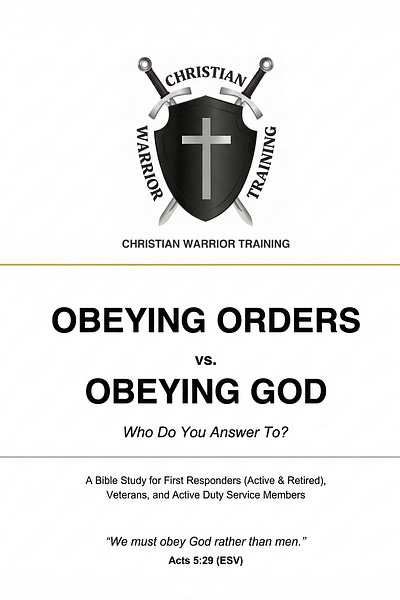
Reflect on the study this week by completing this study guide.

Thanks. I've been living with "looking the other way." It took a physical toll in chronic illness, and I left that profession and corporate career decades ago. And as I have time now to reflect, it would have been very hard personally to be a whistleblower, but my quiet compromise was to just walk away.
Unfortunately for our corrupt society most don't walk or whistleblow. Where is that christian moral compass gone?
Nazi criminals used "following orders" as their defense at the Nuremberg Trials, it didn't hold water. However only 17 were executed. Most were released after only a few years...